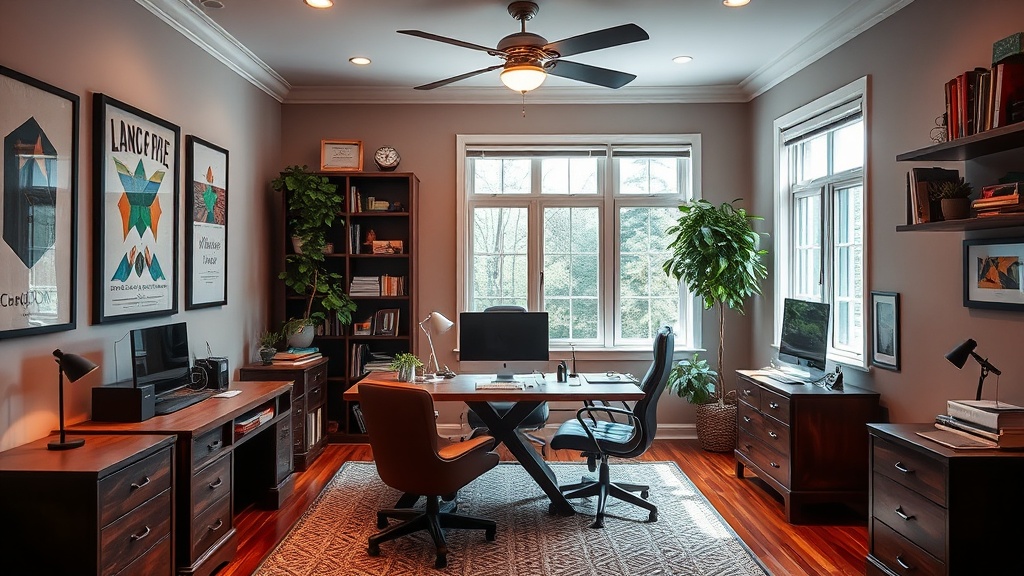
Building a High-Quality Home Office That Actually Works

Imagine you’re sitting at a desk that feels more like a cluttered afterthought than a workspace. You’re trying to focus on a complex project, but the lighting is harsh, your chair is causing back strain, and the constant visual noise of unorganized cables is pulling your attention away. This isn't just a minor annoyance; it’s a direct drain on your productivity and your mental clarity. Creating a dedicated workspace isn't about buying the most expensive-looking furniture you see on Instagram. It’s about intentionality—choosing pieces and layouts that support your specific way of working.
A well-designed workspace serves two purposes: it protects your focus and it preserves your physical well-being. When your environment is chaotic, your mind often follows suit. By focusing on ergonomics, lighting, and organization, you create a boundary between your professional duties and your personal life. This guide looks at how to build a functional, high-end workspace that fits your lifestyle without feeling like a sterile corporate cubicle.
How much space do I actually need for a home office?
The biggest mistake people make is thinking they need a whole room to be productive. In reality, a dedicated corner with a high-quality desk and a comfortable chair can be more effective than a massive, poorly planned room. The goal is to define a boundary. If you’re working in a multipurpose room, use a rug or a specific piece of furniture to signal to your brain that this area is for work only.
If you have the luxury of a separate room, pay attention to the flow. You don't want to feel boxed in. A desk positioned near a window can provide natural light, which is great for mood, but you must consider the glare on your monitor. A desk placed in the middle of a room can feel more authoritative, while a desk facing a wall might minimize distractions but can feel claustrophobic over long periods. You might want to consult the Architectural Digest for ideas on how to integrate a workspace into a living area without sacrificing the room's aesthetic appeal.
For those in smaller apartments, consider a "cloffice" (a closet converted into an office) or a sleek, wall-mounted desk. The key is that the space must feel intentional. If it looks like a temporary setup, you won't treat your work with the same level of seriousness. A high-quality desk—perhaps something in solid wood or a polished metal frame—sets a much different tone than a folding table from a big-box store.
What are the best ergonomic setups for long workdays?
If you spend eight hours a day at a desk, your body will eventually pay the price for a bad setup. Ergonomics isn't just a buzzword; it’s a necessity for long-term health. Your eyes should be level with the top third of your monitor. If you're looking down at a laptop, you're begging for neck pain. A laptop stand and a separate keyboard/mouse combo is a non-negotiable investment here.
Your chair is arguably your most important tool. Look for a chair that offers lumbar support and allows your feet to rest flat on the floor. Your knees should be at a 90-degree angle. Avoid those "aesthetic" velvet chairs that look beautiful in photos but offer zero support; they are a recipe for a sore back. Instead, look for highly adjustable task chairs that allow you to tweak the height, armrests, and tilt.
Even with a great chair, you must move. A standing desk is a fantastic option, but don't feel pressured to stand all day. The most effective way to use one is to alternate between sitting and standing every hour or so. This keeps your circulation moving and prevents that mid-afternoon slump. You can find excellent ergonomic research and guidelines through the Occupational Safety and Health Administration to ensure your setup meets standard safety-driven ergonomic needs.
Organizing your desk without the clutter
Visual clutter is the enemy of deep work. A desk covered in loose pens, stray papers, and tangled cords sends a signal to your brain that things are out of control. To keep a clean surface, you need a system for everything.
- Cable Management: This is the most underrated part of a high-end setup. Use cable trays under your desk or even simple velcro ties to keep cords tucked away. A visible web of wires is an instant way to make a workspace look cheap.
- The One-In, One-Out Rule: If you add a new notebook or a new gadget to your desk, remove something that is no longer useful. This prevents the slow creep of clutter.
- Analog Tools: Even if you are a digital native, having a single, high-quality notebook and a nice pen can be a great way to brainstorm away from a screen. Keep them in a specific tray so they don't drift across the desk.
Think of your desk as a curated collection of tools rather than a dumping ground for various tasks. When everything has a designated home—a drawer, a tray, or a specific shelf—you spend less time searching for things and more time actually doing the work. This level of organization allows you to enter a state of flow much more easily.
Is a high-end desk worth the investment?
There is a significant difference between a desk that holds your computer and a desk that serves as a piece of furniture. A high-quality desk is a long-term investment in your daily experience. Cheap particle-board desks tend to wobble, which is incredibly frustrating when you're typing or writing. A solid, heavy desk provides a sense of stability—both literally and figuratively.
When you invest in quality, you are also investing in the aesthetic of your home. A well-made desk becomes part of your interior design. It shouldn't look like a piece of office equipment that was dropped into your living room; it should feel like a natural extension of your style. Whether it’s a minimalist glass desk or a heavy oak piece, the quality of the materials impacts how much you'll enjoy spending time in that space.
Beyond the physical piece, consider the mental impact. When you sit down at a desk that feels substantial and well-made, you are essentially telling yourself that your work is important. This psychological shift is subtle, but it’s a real part of why a dedicated, high-quality workspace can improve your professional output. It’s about creating an environment that commands respect and builds focus.