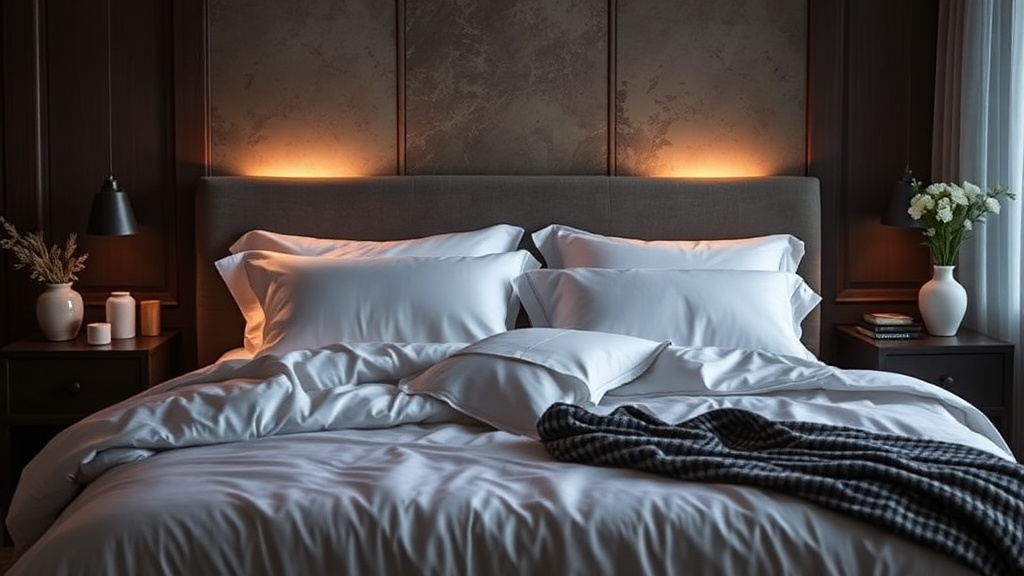
Selecting High-End Bed Linens That Actually Improve Your Sleep

Why does your bed feel like an oven halfway through the night?
Most of us spend a small fortune on a mattress that promises the world, yet we often overlook the very layer that touches our skin for eight hours. It is a common mistake. You buy the thickest, most expensive-looking set of sheets in the store because the packaging mentions a four-digit thread count and a name that sounds vaguely European. Then, you wake up sweaty and restless. This guide covers the specific mechanics of fabric weaves, the reality of material sourcing, and why the way you wash your sheets is probably ruining them. Getting this right matters because your sleep quality is the foundation of your daily performance, and the wrong linens are a literal barrier to resting well.
What is the difference between percale and sateen for hot sleepers?
If you have ever checked into a high-end hotel and felt that specific, crisp coolness against your legs, you were likely sleeping on percale. Percale is a simple one-over, one-under weave. It is designed for breathability. Think of a well-pressed button-down shirt; it has a matte finish and a structure that allows air to move through the fibers. For anyone living in a climate like Denver—where the air is dry but the nights can still feel stuffy—percale is usually the right call. It keeps you cool because it does not cling to your body (a vital distinction for those who toss and turn).
Sateen, on the other hand, uses a different structure where several threads go over one. This creates a much smoother, lustrous surface that feels closer to silk. It is heavier, it drapes more closely to your skin, and it traps significantly more heat. While sateen feels incredibly luxurious in a cold showroom, it can feel suffocating if your bedroom temperature creeps above 68 degrees. You should choose sateen only if you are someone who is perpetually cold or if you prefer a bed that feels like a soft, heavy cocoon rather than a fresh, airy space. The choice between these two isn't about which is better in a vacuum—it is about how your body regulates temperature at night.
Does thread count actually indicate high quality anymore?
Marketing departments have turned thread count into a metric that is almost entirely meaningless. You will see packages boasting 1000 or 1200 threads per inch, but these numbers are often achieved through a bit of creative math. Manufacturers take thin, low-grade fibers and twist them together into a single "ply." They then count each individual strand in that twisted yarn as a separate thread. This results in a sheet that is thick, heavy, and prone to pilling after just a few washes. In reality, a thread count between 200 and 400 is the sweet spot for high-quality cotton. If the cotton is long-staple (like genuine Egyptian or Supima), it is naturally stronger and softer without needing to be bundled into a heavy, unbreathable mess. According to The Sleep Foundation, the quality of the fiber itself is a much better predictor of comfort than the total number of threads.
The biggest lie in the bedding industry is that more is always better; in reality, high thread counts often just mean the manufacturer is hiding cheap material behind a dense weave.
When you are shopping, look for the term "long-staple cotton." This refers to the length of the individual cotton fibers. Longer fibers mean fewer ends are exposed, which results in a smoother surface that will not get scratchy or "fuzzy" over time. It is an investment in longevity. You might pay more upfront for a 300-count long-staple percale set than you would for a 1000-count bargain set, but the former will likely last you a decade while the latter will end up in the rag bin within eighteen months. You can find more technical breakdowns on fabric durability at Architectural Digest.
How should you wash luxury linens to make them last?
Buying the right sheets is only half the battle; most people destroy their linens in the laundry room. The urge to use high heat and aggressive detergents is understandable—you want your bed to be clean—but these are the enemies of natural fibers. Hot water breaks down the molecular structure of cotton and linen, leading to shrinkage and brittle threads. Always wash your high-end bedding in cool or lukewarm water. Also, stop using fabric softeners immediately. These products do not actually soften the fabric; they coat the fibers in a thin layer of wax or silicone. This coating makes the sheets feel slippery in the short term, but it also makes them less absorbent and eventually leads to a dingy, yellowish buildup that is impossible to remove.
Drying is where the most damage happens. If you have the space and the time, air drying is the best way to preserve the integrity of the weave. Since most of us live in the real world and need to use a dryer, use the lowest heat setting possible. High heat cooks the fibers (literally making them snap). Take the sheets out while they are still slightly damp and put them back on the bed or fold them immediately. This helps prevent the deep wrinkles that usually lead people to reach for an iron—which is just another source of heat damage you want to avoid. If you are curious about the most effective detergents for natural fibers, Wirecutter has tested several that do not rely on harsh chemicals.
The truth about linen vs. cotton
Linen is the honest person's bedding. It is made from flax, and it is significantly more durable than cotton—like, pass-it-down-to-your-kids durable. It also has a unique texture that some people find slightly rough at first. However, linen gets softer with every single wash. It is the most breathable material you can buy, making it a favorite for Denver summers. The downside is that it wrinkles if you even look at it sideways. You have to be okay with a bed that looks a little lived-in. If you want a crisp, perfectly smooth aesthetic, stick with cotton percale. If you want a bed that feels like a natural extension of a relaxed, high-end lifestyle, linen is worth the higher price tag.
Ultimately, your bed should be a place where you actually want to spend time, not just a place where you crash because you are exhausted. Spending a bit more on the right material—and taking the time to care for it properly—is not about being fussy. It is about recognizing that the environment you sleep in dictates the mood of your entire next day. Skip the 1200-count gimmicks at the big-box stores and look for real materials that breathe. Your body will notice the difference within the first hour of lying down, and your morning self will thank you for the foresight.