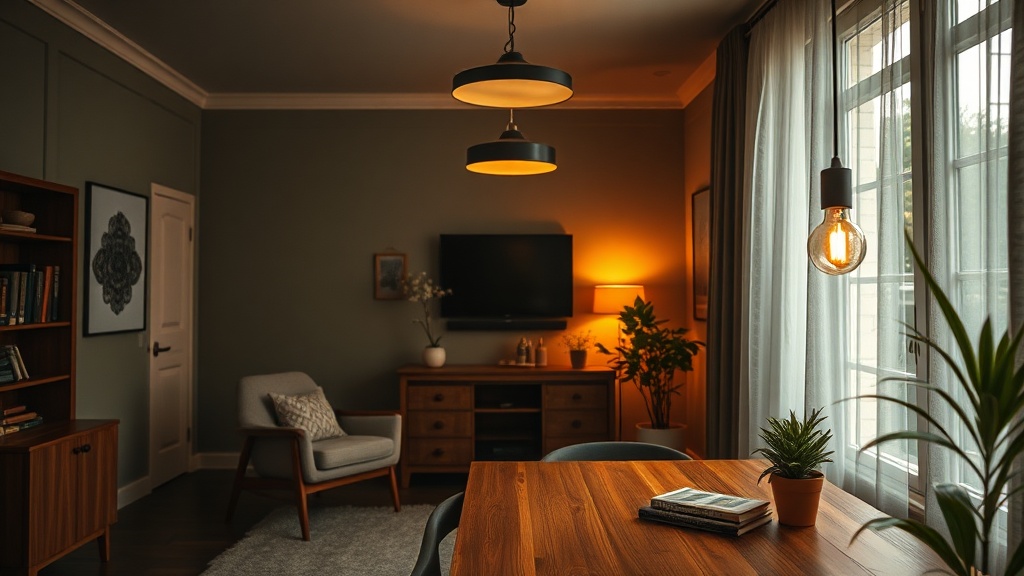
Why Your Home Lighting Dictates Your Daily Mood

Studies show that exposure to improper light wavelengths can disrupt your circadian rhythm, potentially impacting your sleep quality and cognitive function. Light isn't just a way to see your surroundings; it's a biological trigger. When we talk about the way a room feels, we often focus on furniture or color, but the light—the way it hits a surface or casts a shadow—is what actually dictates the atmosphere. Understanding how to manipulate brightness, color temperature, and placement can change how you experience your own living space every single day.
Is Warm Light Better for Evening Relaxation?
Most people reach for a standard overhead light when they enter a room, but that's often the quickest way to ruin a relaxing evening. Overhead lighting is typically harsh and unforgiving. It creates deep shadows under your eyes and makes a space feel sterile. Instead, the goal should be to pull the light down to your level. Think about the height of your eye line when you're sitting on a sofa or reading a book.
Warm light—specifically in the 2700K to 3000K range—mimics the setting sun. This tells your brain that the day is winding down. If you're constantly under bright, cool-toned lights (the kind found in many offices or kitchens), your body remains in a state of high alert. This isn't just about aesthetics; it's about biological signals. If you want to wind down, you need to ditch the "daylight" bulbs for something softer. You can find excellent technical breakdowns of color temperatures at Energy.gov to understand how different bulbs function.
A well-designed room uses layers. You shouldn't rely on a single source. Instead, combine a floor lamp, a small table lamp, and perhaps a dimmable sconce. This creates depth. A single bright light source flattens a room, making it feel small and utilitarian. Multiple low-level light sources make a room feel expansive and inviting.
Does Natural Light Affect Productivity?
The relationship between sunlight and productivity is well-documented. Natural light provides a full spectrum of light that keeps us alert and focused. However, the challenge in many modern homes is managing the transition from bright daylight to the dimness of evening. If your workspace is tucked in a dark corner, you'll likely feel a slump by mid-afternoon. This isn't just a lack of caffeine; it's a lack of visual stimulation.
To fix this, don't just open the blinds. Consider how the light enters. Using sheer curtains can diffuse harsh sunlight, creating a soft, consistent glow that prevents glare on computer screens. If you can't access much natural light, high-quality full-spectrum lamps can help bridge the gap. You want to avoid the "cave effect" where your workspace feels disconnected from the world outside. A bright, well-lit desk area can actually signal to your brain that it's time to focus, whereas a dim, yellowish light might signal it's time for a nap.
If you're looking to understand more about the physiological impact of light, the Sleep Foundation offers great insights into how light affects our internal clocks. It's about more than just being able to see; it's about how your environment talks to your nervous system.
Can Smart Lighting Improve Daily Routines?
The rise of smart-home technology has made it easier than ever to automate your environment. You don't need to manually flick switches every time you move from the kitchen to the living room. You can program your lights to follow a schedule that aligns with your natural rhythms. Imagine your lights slowly brightening in the morning to mimic a sunrise, or dimming to a deep amber hue at 8:00 PM. This isn't high-tech-for-the-sake-of-it; it's about creating a seamless transition through your day.
Smart bulbs allow for granular control over the intensity and color of your space. If you're hosting a dinner, you might want a lower, warmer setting. If you're cleaning the house, you might need a brighter, cooler light to see every speck of dust. The ability to change the "vibe" of a room with a single tap or a voice command changes how you interact with your home. It turns your living space from a static box into a dynamic environment that responds to your needs.
Consider these common light levels for different activities:
- Task Lighting: Focused, bright, and direct (reading, cooking, sewing).
- Ambient Lighting: Soft, diffused, and widespread (general movement through a room).
- Accent Lighting: Highlighting specific objects or architectural features (art, bookshelves, plants).
When these three work together, your home feels intentional. It doesn't feel like a collection of rooms, but a cohesive experience. A room with only one type of light will always feel "off"—either too harsh and clinical or too dark and uninviting. By balancing these layers, you create a space that supports whatever you're doing, whether that's intense work or deep relaxation.